Tomar and the Templars
Two hours north to the Convent of Christ — a fortress-monastery of eight cloisters, one legendary window, and the order that outlived its own dissolution.
The short version
- Direct CP trains leave Lisbon (Santa Apolónia and Oriente) for Tomar roughly hourly and take about two hours — fares at cp.pt. The convent is a 20-minute walk uphill from the station, or a five-minute taxi.
- The Convento de Cristo costs €15, opens daily, and fills 90 minutes to two hours: details at conventocristo.gov.pt.
- The Charola — the Templars’ 12th-century round oratory, built so knights could hear mass on horseback by the tale — is the core, wrapped in gold and painting under a sixteen-sided drum.
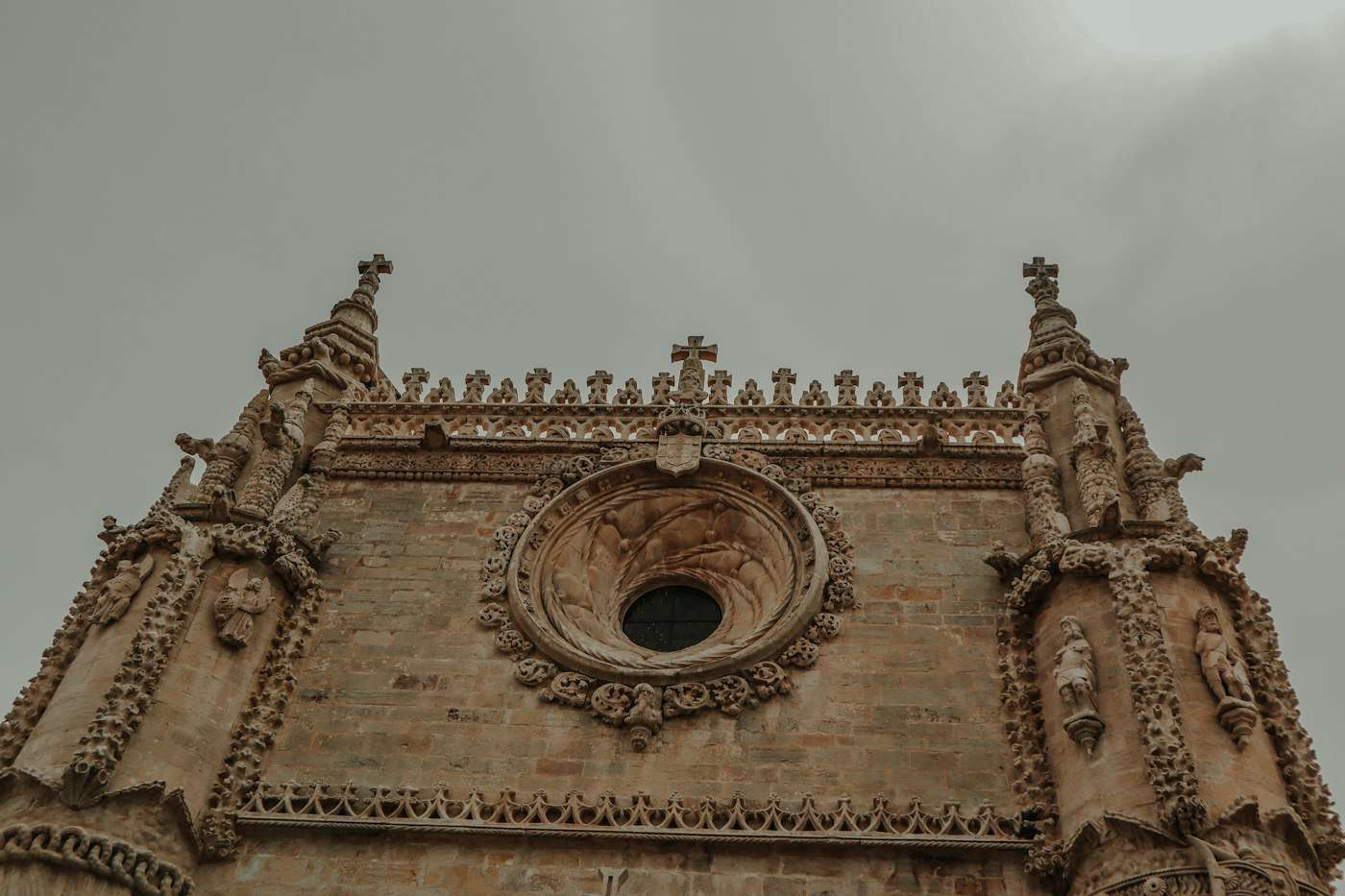
- The Chapter House window is the Manueline style’s single most famous carving: ropes, coral, seaweed, and armillary spheres in stone, best seen from the Santa Bárbara cloister terrace.
- Down in town, Portugal’s best-preserved medieval synagogue and the riverside old centre fill the pre-train hour; the Festa dos Tabuleiros, when girls parade towers of bread and flowers on their heads, takes over Tomar every four years — 2027 is the next.

Getting there
CP regional and intercity services run direct from Lisbon’s Santa Apolónia and Oriente stations to Tomar about once an hour; the ride takes two hours, and Tomar is the end of the line, which removes all doubt about where to get off. From the station, the town centre is flat and immediate; the convent sits above it — 20 minutes on foot uphill through the woods, or a quick taxi. Drivers take the A1 and A23, about 90 minutes.
The day
Go straight up to the convent while your legs are fresh. The Knights Templar built the castle and the round Charola in the 1160s as the order’s Portuguese headquarters; when the Templars fell across Europe in 1312, Portugal simply rebadged them as the Order of Christ, and their cross went on to fly from every caravel of the Discoveries. Inside, the Charola glows — a Byzantine-feeling drum of gilt and painting — and the monastery around it accumulates cloisters like tree rings, from Gothic to Renaissance. The Chapter House window is the reason photographs exist: a stone cascade of everything Portugal’s sea empire touched, knotted ropes to coral. Walk the aqueduct’s arrival if time allows, then descend to town for the synagogue on Rua Dr. Joaquim Jacinto — Portugal’s oldest surviving one, a plain and moving room — and coffee on the Nabão riverside. The famous convent-sweets shops by the square handle the train snack.
When to go
Year-round: the convent is a stone world of its own in any weather, and Tomar suffers none of Sintra’s congestion. Spring and October give the climb its best temperatures. Every fourth July the Festa dos Tabuleiros — next in 2027 — fills the town with bread-crowned processions; lodging becomes impossible and the spectacle, by every account, repays the trouble. Plan around it either way.
Frequently Asked Questions
How do you get to Tomar from Lisbon?
Direct CP trains from Santa Apolónia via Oriente, roughly hourly, about two hours, ending at Tomar. The convent is a 20-minute uphill walk or short taxi from the station.
What does the Convento de Cristo cost?
€15 for adults, with the usual reductions, open daily (closed only a handful of holidays). Give it 90 minutes to two hours — the complex covers a castle, the Charola, and eight cloisters.
What is the Charola?
The Templars’ 12th-century round church, modeled on Jerusalem’s Holy Sepulchre rotunda — a sixteen-sided drum, gilded and painted, that the later monastery grew around. It is the emotional core of the visit.
Why is the window such a big deal?
The Chapter House window is the defining piece of Manueline carving: maritime Portugal rendered in stone — ropes, coral, chains, spheres — crowned with the Order of Christ cross. Art history classes teach the style from this one window.
What else is in Tomar itself?
Portugal’s best-preserved medieval synagogue, a pleasant riverside old town, and serious conventual pastry. Every four years the Festa dos Tabuleiros (next: 2027) parades towers of bread and paper flowers through the streets — one of Portugal’s great festivals.